
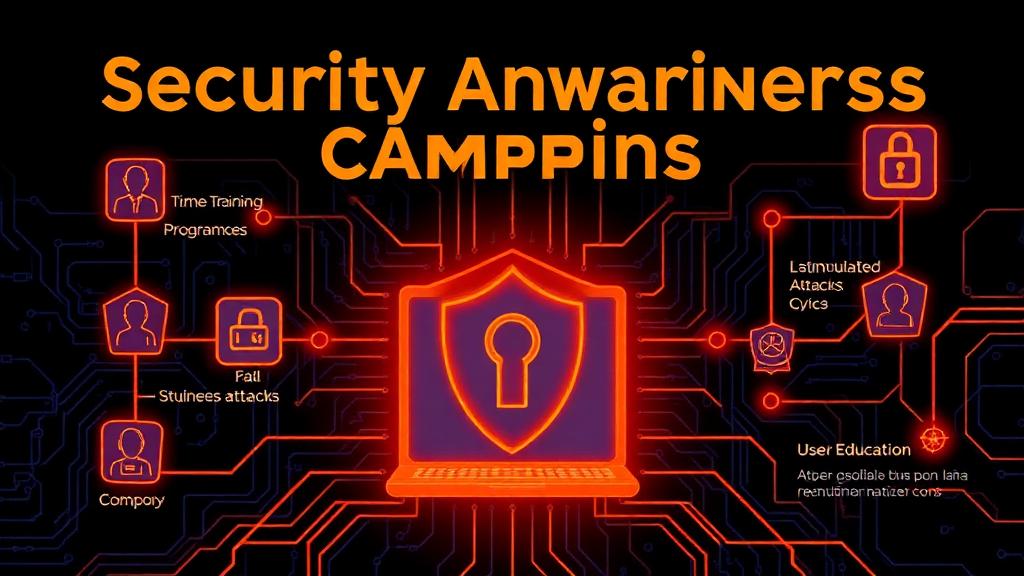
Security Awareness Campaigns
Security awareness campaigns are structured, continuous programs to educate employees about cyber threats, develop secure behaviors, and transform users from a vulnerability (the weakest link frequently exploited by attackers via phishing, social engineering, and misconfigurations) into an active line of defense that identifies and reports attacks before they cause significant damage - organizations that invest in effective awareness programs see measurable reductions in successful phishing attacks (from a 30% click rate to below 5%), increased security incident reporting by users (detecting threats before they escalate), and a cultural shift where security becomes a shared responsibility rather than just an IT department concern. Effective campaigns go beyond compliance checkboxes and mandatory annual training that employees sleep through - they use multiple channels and formats for continuous engagement (monthly phishing simulations keep vigilance high, newsletters with recent breach case studies maintain relevance, posters in common areas provide micro-learning moments, lunch-and-learns with external speakers bring new perspectives, gamification with leaderboards and prizes encourages participation, and microlearning modules of 3-5 minutes consumable on mobile devices fitting into busy schedules), contextually relevant content aligned with current threats and calendar events (a campaign on travel security before the holiday season, tax scam awareness before the fiscal deadline, awareness of phishing campaigns directed at the organization after detected attempts), personalized messages based on role and risk (executives receive training on whaling and BEC, developers on secure coding and supply chain attacks, HR on social engineering targeting employee data, finance on wire transfer fraud), and robust metrics for measuring effectiveness and continuous improvement (not just completion rates but behavioral changes such as phishing click rates, report rates, policy compliance incidents, and security culture surveys).
Phishing Simulations and Behavior-Based Training
Phishing simulations are controlled exercises where the security team sends emails simulating real attacks to employees, tracking who clicks malicious links, submits credentials on fake pages, or reports the email as suspicious - data from these simulations informs targeted training for high-risk individuals and groups. Effective implementation: use specialized platforms (KnowBe4, Cofense, Proofpoint Security Awareness) that provide phishing templates based on current threats, realistic landing pages, and automated training enrollment, start with obvious simulations (Nigerian prince scams) to build confidence and gradually increase sophistication matching real-world threats (personalized spear phishing, CEO fraud, credential harvesting disguised as internal IT notices), run simulations monthly or bi-weekly to maintain vigilance without causing fatigue, vary timing and content to avoid predictability (attackers do not give advance notice), and use multi-lingual templates if the workforce is global. When an employee clicks on a simulation: redirect to a brief educational page explaining what went wrong and how to identify phishing in the future (not punitive but a teachable moment), automatically enroll them in a micro-training module on phishing recognition, and track repeat offenders who click on multiple simulations for targeted intervention (one-on-one conversation with a manager, enhanced training, or restricted access to critical systems if necessary). Celebrate and reward employees who correctly report simulations (public recognition, security champion badges, entry into prize drawings) to reinforce positive behavior - the goal is to normalize reporting suspicious emails rather than silently deleting them out of fear of appearing incompetent. Analyze simulation results by department, job function, and seniority to identify high-risk groups needing enhanced training (marketing and HR are frequently targeted, executives are whaling targets, newer employees may lack institutional knowledge of legitimate communication patterns).
Multiple Communication Channels and Formats
Single-channel awareness programs fail because different people learn in different ways and modern attention spans are fragmented - effective campaigns use a diversified mix of channels. Email newsletters monthly or biweekly provide deep dives into security topics, recent breach case studies with lessons learned, practical tips, and updates on new threats targeting the industry (keep them concise with visual graphics, use storytelling rather than technical jargon, and include clear calls-to-action such as "report suspicious emails to the security team"). Posters and digital signage in lobbies, elevators, cafeterias, and near printer/copier stations provide bite-sized reminders during the workday (examples: "Lock your screen when leaving your desk," "Don't plug in unknown USB drives," "Verify requests for wire transfers via a secondary channel," with memorable visuals and a simple message). An intranet security hub centralizes resources such as policy documents, reporting mechanisms, training modules, FAQs, and contact information for the security team - make it easily accessible and regularly updated. Short videos (2-3 minutes) demonstrating attacks such as phishing email anatomy, social engineering tactics, and secure password creation are more engaging than slide decks and shareable via Teams/Slack. Lunch-and-learn sessions bring variety with live presentations, Q&A opportunities, and networking (invite external speakers from the local FBI cyber division, incident response vendors, or breach victims for real-world perspectives). Slack/Teams bots send daily security tips, quiz questions with prizes for correct answers, and instant guidance when employees ask security questions. Gamification turns learning into a competition with leaderboards, badges for completing trainings, and team challenges (the department with the lowest phishing click rate wins a lunch party).
Relevant and Contextualized Content
Generic security training fails to resonate because employees see it as irrelevant to their daily responsibilities - contextualization based on role, industry, current events, and organizational incidents drives engagement and retention. Role-based content: executives receive training on Business Email Compromise (BEC) and whaling attacks specifically targeting the C-suite via spoofed emails requesting urgent wire transfers, developers learn about secure coding practices, dependency vulnerabilities, and supply chain risks in open-source libraries, HR personnel are educated on social engineering tactics seeking employee personal information and recruitment scams, finance teams focus on wire transfer fraud, invoice manipulation, and vendor impersonation. Industry-specific threats: healthcare organizations emphasize ransomware targeting hospitals and HIPAA compliance, financial institutions cover payment fraud and PCI-DSS requirements, retailers focus on point-of-sale compromise and e-commerce fraud, and manufacturing addresses industrial espionage and OT/ICS security. Timely content aligned with the calendar and current events: tax season awareness about IRS impersonation scams, the back-to-school period covering children's online safety for work-from-home parents, the holiday shopping season addressing e-commerce fraud and package delivery scams, the travel season with wifi security and device theft prevention, and immediate alerts after high-profile breaches explaining the attack vector and how employees can protect themselves. Organizational incidents: when your organization experiences an attempted or successful attack, use it as a teachable moment with an all-hands communication explaining what happened, the impact, lessons learned, and what employees should do differently (de-identify if necessary to protect individuals but share enough detail to be educational).
Metrics, Measurement, and Continuous Improvement
"What gets measured gets managed" - effective awareness programs require robust metrics demonstrating ROI, identifying gaps, and guiding continuous improvement. Track leading indicators that measure program health: training completion rates (target 95 percent plus annually, 100 percent for new hires within 30 days), phishing simulation performance over time (track click rate, credential submission rate, and critically report rate trending upward), time-to-complete assigned trainings (delays indicate low priority or accessibility issues), and engagement metrics with awareness materials (email open rates, video views, intranet page visits). Track lagging indicators that measure actual security outcomes: number of security incidents caused by employee error (a declining trend indicates effectiveness), successful phishing attacks that bypassed technical controls (should decrease as users become better at identification), frequency of policy violations (USB usage, shadow IT, data mishandling), and employee-reported suspicious activities that turned out to be actual threats (increasing reporting is a positive sign). Conduct security culture surveys annually measuring employee attitudes toward security, perceived importance, confidence in identifying threats, knowledge of policies, and willingness to report incidents - compare across departments, track year-over-year trends, and benchmark against industry peers. Use metrics to identify training gaps: if specific phishing templates consistently fool employees, create targeted micro-learning addressing that attack vector, if a particular department underperforms, deploy enhanced training or investigate underlying issues (workload pressures, cultural factors, inadequate management support). Report metrics to leadership demonstrating program value: quantify risk reduction (X percent decrease in phishing susceptibility), calculate cost avoidance (breaches prevented, ransomware attacks detected early by alert users), and highlight positive culture shifts (employees proactively reaching out with security questions, security champions emerging in departments).