
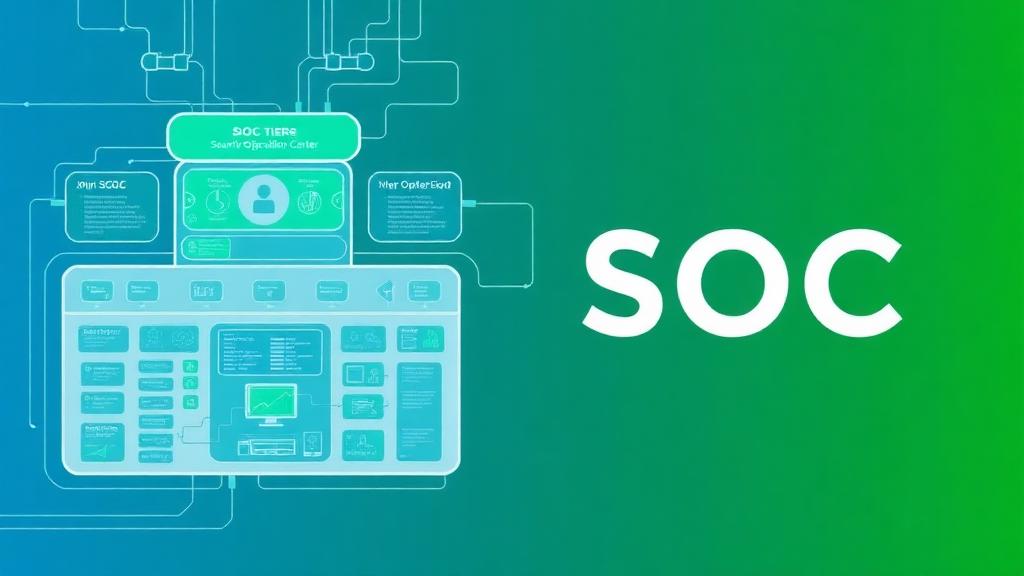
SOC Design: Architecture and Structure
Designing an effective Security Operations Center (SOC) requires strategic planning that spans technological architecture, organizational structure, operational processes, and performance metrics. A well-designed SOC operates as the central nervous system of organizational cybersecurity, providing continuous 24/7/365 monitoring, proactive threat detection, incident analysis, and coordinated response to security events. The tier architecture (L1, L2, L3) clearly defines responsibilities and escalation: L1 analysts (Tier 1) perform initial alert triage, apply predefined playbooks, and escalate complex cases; L2 (Tier 2) conducts in-depth investigations, event correlation, and threat hunting; L3 (Tier 3) acts as technical specialists, developing custom detections, performing forensic analysis, and continuously improving the technology stack. The modern technology stack integrates SIEM (Security Information and Event Management) for log aggregation and correlation, SOAR (Security Orchestration, Automation and Response) for workflow automation, EDR (Endpoint Detection and Response) for endpoint visibility, NDR (Network Detection and Response) for traffic analysis, Threat Intelligence Platforms for threat context, and Case Management Systems for incident tracking. Beyond technology, well-defined processes for triage, escalation, communication, and shift handoff ensure smooth operation, while metrics such as MTTD (Mean Time to Detect), MTTR (Mean Time to Respond), alert fatigue rate, and false positive ratio enable continuous, data-driven improvement.
Tier Structure and Responsibilities
The tier structure is fundamental to scalability and specialization in the SOC. Tier 1 (L1) - Security Analysts: the first line of defense, responsible for monitoring dashboards, triaging alerts, initial severity classification, executing predefined playbooks (e.g., blocking a malicious IP, isolating an endpoint), and escalating complex cases. L1 handles a high volume of alerts, prioritizing speed and adherence to procedures. Skills required: knowledge of network protocols, operating systems, SIEM tools, and the ability to follow runbooks. Tier 2 (L2) - Incident Responders: perform deep investigations of escalated incidents, correlation of multiple data sources, malware analysis (basic), proactive threat hunting, tuning of detection rules to reduce false positives, and coordination with IT teams for remediation. L2 requires deep technical skills: log analysis, scripting (Python, PowerShell), and knowledge of threat actor TTPs (Tactics, Techniques, Procedures). Tier 3 (L3) - Security Engineers/Architects: experts who develop custom detections, integrate new data sources, optimize SIEM/SOAR, conduct advanced forensic analysis, threat modeling, and mentoring of L1/L2. L3 often has a specialization (malware reverse engineering, cloud security, threat intelligence).
The Modern SOC Technology Stack
SOC effectiveness depends on integrated technologies: SIEM (Splunk, IBM QRadar, Microsoft Sentinel): the core platform for log aggregation from firewalls, IDS/IPS, endpoints, cloud, and applications; a correlation engine to detect suspicious patterns; dashboards for real-time visibility; and alerting based on rules and machine learning. SOAR (Palo Alto Cortex XSOAR, Splunk Phantom, IBM Resilient): orchestrates automated response through playbooks (e.g., receive a phishing alert → enrich with threat intel → check whether other users clicked → isolate affected endpoints → notify users); integrates with 100+ tools via APIs; case management for incident tracking. EDR/XDR (CrowdStrike, SentinelOne, Microsoft Defender): deep endpoint visibility, behavioral malware detection, automatic containment, forensic data collection. Network Detection and Response (NDR): traffic analysis using DPI (Deep Packet Inspection), detection of lateral movement, C2 communication, and data exfiltration. Threat Intelligence Platform (TIP): aggregates threat intel feeds (OSINT, commercial, ISACs), enriches alerts with IOCs (Indicators of Compromise), and automates the blocking of malicious IPs/domains. Vulnerability Management: prioritizes patching based on exploitability and criticality.
Operational Processes and Playbooks
Well-defined processes ensure consistency and efficiency: Alert Triage Workflow: (1) L1 receives an alert via SIEM; (2) validates whether it is a true positive or false positive using context (e.g., an admin login alert at 3AM - check whether it is scheduled maintenance); (3) classifies severity (Critical/High/Medium/Low); (4) if a true positive, executes the initial containment playbook; (5) escalates to L2 if deep investigation is needed. Incident Response Playbooks: document step-by-step procedures for common scenarios: malware infection (isolate host, dump memory, collect artifacts, analysis, eradication, recovery), phishing campaign (identify scope, block sender, remove emails from all mailboxes, credential reset for those who clicked), DDoS attack (activate upstream mitigation, scale infrastructure, communicate with stakeholders). Shift Handoff Process: at the end of a shift, the analyst documents: open cases with current status, pending alerts, suspicious events under monitoring, and expected actions for the next shift. Escalation Criteria: defines when to escalate: production impact, involvement of executives/VIPs, evidence of APT, confirmed data exfiltration, or a technical impasse. Communication Protocols: templates to notify stakeholders, IT teams, management, and external parties (clients, partners, authorities).
Effectiveness Metrics and KPIs
Measurement is critical for continuous improvement: Mean Time to Detect (MTTD): the average time from the start of an attack to detection. Benchmark: high-performing organizations detect within minutes/hours; the global average is days/weeks. Reducing MTTD requires: high-fidelity detections, proactive threat hunting, and threat intelligence integration. Mean Time to Respond (MTTR): the time from detection to containment/remediation. Reducing MTTR: SOAR automation, well-tested playbooks, and integration with IR tools. Alert Volume and False Positive Rate: a high volume of false positives causes alert fatigue, where analysts ignore legitimate alerts. Target: <10% false positive rate through continuous tuning of detection rules. Coverage Metrics: % of assets monitored, % of logs ingested into the SIEM, % of MITRE ATT&CK techniques covered by detections. Incident Metrics: number of incidents by category (malware, phishing, DDoS, insider threat), trends over time. Analyst Performance: average triage time per analyst, classification accuracy, escalations required. SLA Compliance: adherence to internal SLAs (e.g., respond to Critical alerts in <15min). An executive dashboard consolidates metrics for leadership visibility.
Integration with CSIRT and Threat Intelligence
The SOC does not operate in silos: Integration with CSIRT (Computer Security Incident Response Team): the SOC focuses on detection and continuous monitoring; the CSIRT on deep response to serious incidents. Handoff: when the SOC detects a high-severity incident, it escalates to the CSIRT, which takes over coordination of forensics, eradication, recovery, and post-mortem. Overlap: L2/L3 analysts frequently participate in both. Threat Intelligence Integration: external feeds (commercial, ISAC, OSINT) are ingested into the TIP and automatically cross-referenced with SIEM logs; malicious IOCs (IPs, domains, file hashes) are blocked at the firewall/proxy; threat actor TTPs are used to develop custom detections; strategic intel informs about emerging campaigns targeting the industry. Vulnerability Management Integration: when a new critical CVE is published, the VM team identifies vulnerable assets; the SOC increases monitoring for exploits of that vulnerability; patching is prioritized for assets under active attack. Red Team/Purple Team: exercises where the red team simulates attacks and the SOC attempts to detect them; the gaps revealed are used to improve detections, playbooks, and training.
SOC Models: In-House, Outsourced, and Hybrid
Organizations choose different models: In-House SOC: fully managed in-house. Advantages: full control, deep knowledge of the environment, customization. Disadvantages: high cost (headcount, technology, facilities), difficulty recruiting/retaining talent 24/7, limited expertise. Ideal for: large enterprises, regulated sectors, organizations with ultra-sensitive data. Managed SOC (SOC-as-a-Service): outsourced to an MSSP (Managed Security Service Provider). Advantages: predictable cost, access to experts, immediate 24/7 coverage, enterprise-grade technology without CAPEX. Disadvantages: less control, potential for slower response, sharing data with third parties. Ideal for: SMBs, companies without in-house expertise. Hybrid SOC: combines in-house + outsourced. Example: in-house SOC during business hours + MSSP for night/weekend coverage; or MSSP for L1 triage + in-house team for L2/L3. Virtual SOC: geographically distributed, leveraging a follow-the-sun model for global coverage. Fusion Center: a SOC integrated with the NOC (Network Operations Center) and IT Service Desk for holistic visibility.
SOC Implementation and Maturity
Building a SOC is a journey, not a project: Phase 1 - Foundation: implement SIEM, collect critical logs (firewall, AD, email gateway), create basic dashboards, hire the L1 team, define playbooks for top threats (phishing, malware). Phase 2 - Expansion: add EDR, expand log sources (cloud, applications), develop custom correlation rules, hire L2, implement case management. Phase 3 - Optimization: implement SOAR for automation, integrate threat intelligence, begin threat hunting, reduce false positives through tuning, formalize metrics. Phase 4 - Advanced: proactive threat hunting, red team/purple team exercises, machine learning for anomaly detection, deep integration with DevSecOps. Maturity Models: frameworks such as CMMI for Security, NIST CSF (Cybersecurity Framework), or proprietary maturity assessments help benchmark and plan evolution. Continuous Improvement: post-incident reviews identify gaps; tabletop exercises test playbooks; ongoing training keeps the team up to date with the threat landscape; technology refresh ensures the stack remains effective against emerging threats.